Everyone answers every clue. One team’s answer counts.
Questionable! is team trivia on a board of categories, built for meetings, offsites and all-hands. Teams take turns picking a clue, everyone answers on their phone, and the team's most popular answer goes on the board.
On the big screen
🦩Team Flamingo is picking
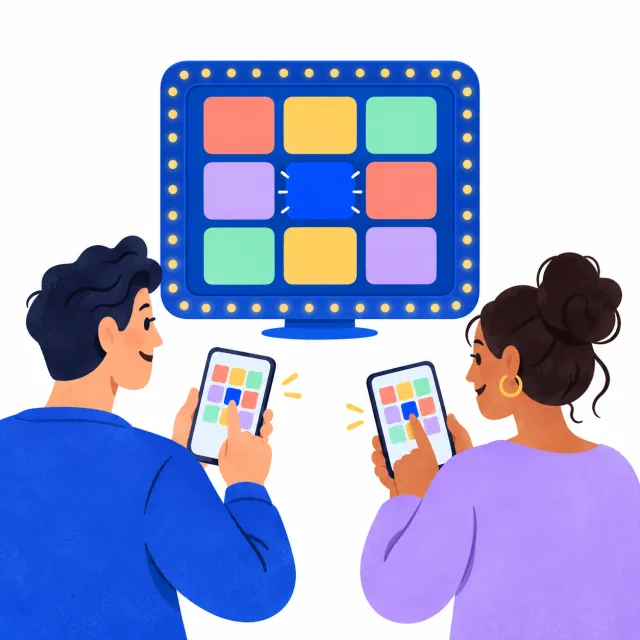
Team Flamingo picks the next clue, and every phone on the team gets a vote.
How it works
- 01
Build a board in a minute
Describe your room and AI writes 6 categories of 5 clues, easiest first, plus a final clue. Or start from one of 10 curated boards, and edit any tile by hand.
- 02
One team picks, everyone answers
The team in control votes for a tile from their phones. The clue goes to every phone in the room, and everyone has 30 seconds to type an answer.
- 03
The team's answer goes on the board
The team in control sees its answers group live and its most popular one counts. If they miss, a team that mostly got it right can steal the points.
Step by step

Step 1: Set up the gameWho: You
Choose teams, assignment method, answer rule, timing, steals, penalties and final round.

Step 2: Join the activityWho: The room
Scan the displayed QR code or open the join link on a phone.

Step 3: Join your teamWho: The room
Follow automatic assignment, select a team, or wait for the captain draft, as configured.

Step 4: Start when everyone's inWho: You
Wait until the teams have players, then press Start the game.
Step 5: Choose a tileWho: The room
The controlling team votes for the next tile from their phones; the first tile to reach the vote target, or the most-voted when time runs out, opens for the room.

Step 6: Type an answerWho: The room
Every player submits a typed answer, including players on other teams.

Step 7: Show results and awardsWho: Everyone
The results follow automatically: team standings, awards and, with individual scoring on, the top players, whether or not a final round was played.
Why everybody answers
Classic team trivia has a quiet problem. One person on each team knows the answer, says it, and the other five wait for the next question. The loudest people in the room play the game, and everyone else watches them do it.
Questionable! gives every clue to every phone. The team in control has to agree, because its most popular answer is the one that counts, so a table starts arguing over the answer instead of deferring to its expert. The other teams answer too, because their answers earn their own points and decide who can steal a miss.
The reveal is where the room comes together: what the team said, whether it was right, the answer, and how many people in the room knew it. Then the board comes back, the scores move, and somebody else is up.
FAQ
Questionable!, explained
How does Questionable! work?
The room splits into teams and plays a board of 6 categories, with clues worth 100 to 500 points. The team in control picks a clue, everyone answers it on their phone, and the team's most popular answer is the one that counts. Get it right and the points are yours, along with the next pick.
Why does everyone answer if only one team's answer counts?
Because every answer still counts for something. Each player earns the clue's points for a right answer, so there is an individual leaderboard running alongside the team one. The other teams' answers decide who can steal a missed clue, and the whole room's answers become the numbers on the reveal, like how many people got it right.
Where do the clues come from?
Three places, and you can mix them. Describe the audience or the topic and AI writes the whole board, final clue included. Give it an answer and it writes the clue, or the other way round, one tile at a time. Or start from one of 10 curated boards, from general knowledge to behavioral science, and change whatever you like.
How are answers marked?
As they arrive, answers that mean the same thing are grouped, so "sunk cost", "the sunk cost fallacy" and a near-miss spelling all land together. If the AI is slow, a built-in matcher takes over that ignores "what is", articles, punctuation and small typos, so the game never waits. You can still mark any answer right or wrong yourself.
How do teams work?
You choose from 2 to 8 teams, 4 by default, and each gets a fun name you can change. People are balanced across teams as they join, or pick their own team, or the first person on each team drafts the rest from the people waiting. Every team has a captain, who can rename the team before the game starts. Switch on captain mode and the captain sees the team's answers and makes the final call, even if that means overruling everyone else.
What happens when a team gets it wrong?
Steals are on by default. Every other team whose members mostly got it right can steal, and the team with the highest share of right answers takes the points and the next pick. A tie goes to the team that answered faster. If nobody can steal, the next team in turn picks. A wrong answer costs nothing by default, or you can make it cost the clue's points.
Is there a final round?
Yes, and it is on by default. Before the final clue appears, each team bets part of its score: the captain's bet in captain mode, otherwise the middle of what the members suggest. Every team answers at once. A right answer adds the bet and a wrong one takes it away, so the scores can still change at the very end.
What can the host control?
Everything that matters in a live room. Answer time is 30 seconds by default and can be set from 10 to 90. From your phone you can pause, add time, close answers early, skip a clue, mark an answer by hand, adjust a score, and go to the final round whenever the room is ready.
What do we get at the end?
A results screen with the winning team, the top players and a set of awards: Room Genius, Best Comeback, Biggest Risk Taker, Most United Team, Fastest Thinker and the Chaos Award. The awards go into the session report too, next to the team scores and how the room did on every clue.
Do participants need an app or an account?
No. They scan a QR code or open a link and play in their phone's browser. Nothing to install and no sign-up.
How many people can play?
The Free plan supports up to 50 participants per live activity, Pro raises that to 150, and Badass supports up to 300. Everyone answers every clue, so a big room means big numbers on the reveal.
Read more
- Games for large groups that keep everyone playing at onceParty games and group games sorted by how many people play at any moment, with where each one breaks as the room grows
- Christmas party games for large groups, adults and the officeChristmas party games for a big room, for adults and for the office, in person or on a video call, from games everyone plays on their phone to classics that need a pen
- Christmas trivia and quiz questions, with every answer checked125 Christmas trivia questions with answers, in seven rounds from easy to hard, and the myths to leave out of your quiz
- Gen Alpha slang: what the words mean, plus brainrot and 6-730 Gen Alpha and brainrot words with what each one means and where it came from, what brain rot really means, the 2026 Words of the Year, and the story of 6-7
- Gen Z slang: what the words mean and where they came from43 Gen Z slang words, with what each one means, where it came from, and how to run a slang quiz with a room
- A game like Jeopardy! for your PowerPoint, where the whole room playsBuild the board in PowerPoint, or let every phone in the room answer