Games for large groups that keep everyone playing at once
Party games and group games sorted by how many people play at any moment, with where each one breaks as the room grows
· Updated
The fun games for large groups have one thing in common: everyone is playing at the same moment. In a game where one person takes a turn while the rest wait, sixty guests at a minute a turn get one minute of play an hour each. The other fifty-nine minutes, they watch.
Ordinary conversation already strains against that arithmetic. Dunbar's census of casual social groups found that conversations have a size limit at around four people. One explanation he weighs is turn-taking. If that is the cause, the limit suggests people grow dissatisfied once they get less than about 20 to 25% of the conversation time. He adds that this still needs testing on conversations followed in real time. A guest waiting for a turn among sixty gets one sixtieth.
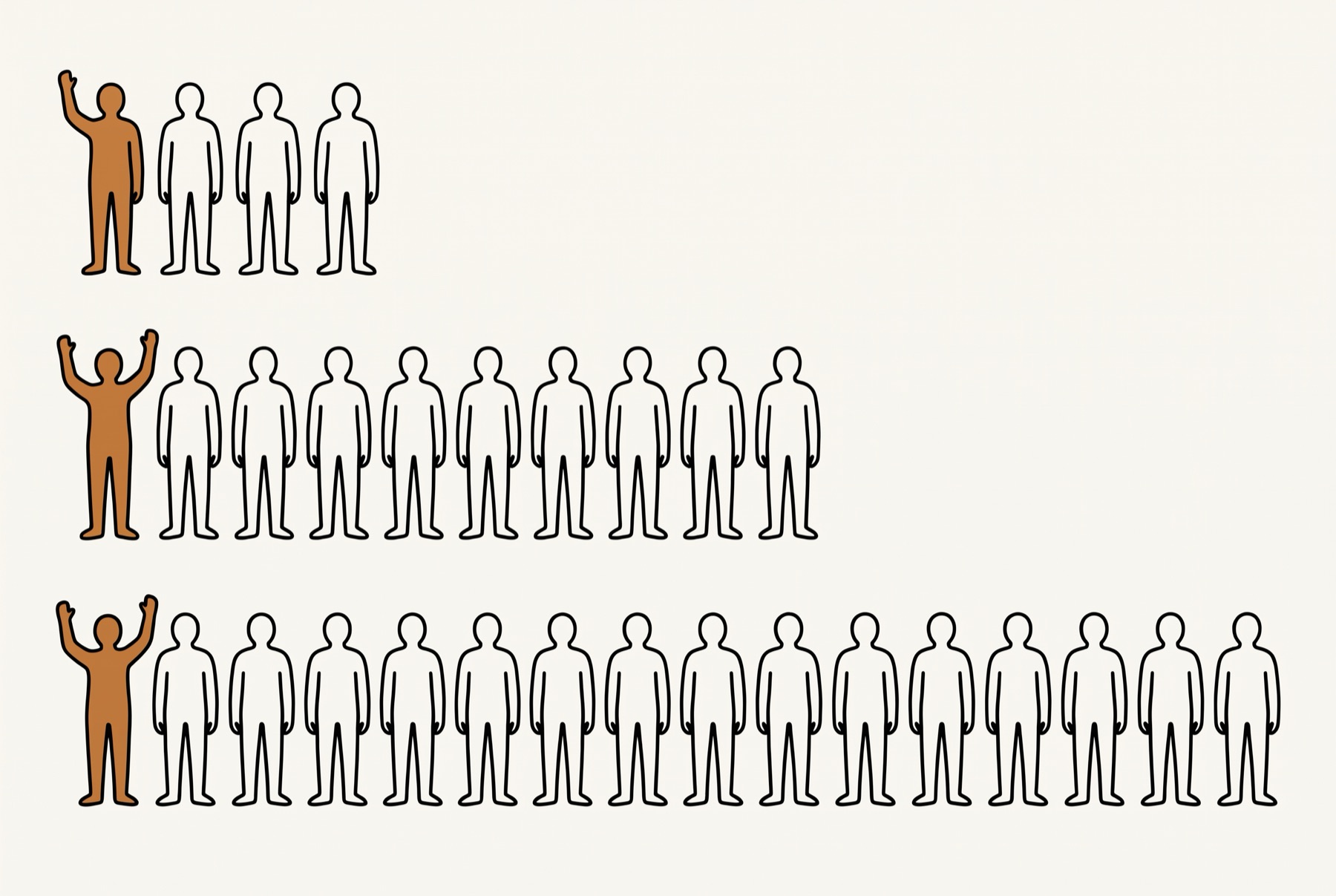
In a game of turns, each player gets a quarter of them in a group of four, a tenth in ten and a sixteenth in sixteen.
Waiting is not the only cost. Latané, Williams and Harkins had students clap and shout as loudly as they could, alone and in groups. Two-person groups reached 71% of the sum of their members' solo efforts, four-person groups 51% and six-person groups 40%.
A second experiment took coordination out of it. Blindfolded and in headphones, each student shouted alone while believing others shouted too. Told that five others had joined in, they shouted only 74% as intensely as alone. The task was shouting rather than a party game, and every participant was a male undergraduate, so it shows the direction of the effect, not its size in your room.
Of the three explanations the authors offered, one was that a group hides each person's share. When people perform together, individual scores are unidentifiable, so nobody gets precise credit or fair blame for their own part.
So the games below are sorted by how many people are playing at any moment, and each comes with a note on where it breaks. The best of them also give every player an answer of their own. Openers for a big room are in icebreaker games, and events for colleagues have their own page, team building activities for work.
How to pick a game for a big group
Three questions settle most of the choice, and the first one matters most.
- How many people are playing at any moment? Count the people doing something, not the people in the room. Charades in two teams keeps one actor and half the room busy. A game answered on phones keeps everyone busy on every prompt.
- Can everyone see and hear it? The back of a big room can't read small print or catch a quiet answer. A game on a big screen puts the words in every player's hand as well. A game played by voice needs a microphone, or circles small enough to hear each other.
- How long does it run as the room grows? A game with a turn for each player, or a round for each drawing, grows with the room. A game of fixed rounds takes as long for two hundred people as for twenty.
| Your room | Start with | Who plays at any moment |
|---|---|---|
| Seated, facing one screen, phones out | Mic Drop, Squadrillion or a live quiz | Everyone, on every prompt |
| Seated, and the room wants sides | Questionable! in teams | Everyone answers every clue |
| A long evening with a story in it | Imposter or Mafia | Everyone votes, though Mafia's players drop out as the game goes on |
| Restless after hours of sitting | Meeting Dodgeball | Every team member works part of the controls |
| Standing, with room to walk | Mingle Match or Group Mixer | Everyone, in pairs or small groups |
| No screen and no phones | Four corners or the silent line-up | Everyone, on their feet |
Every Decka game here runs on one big screen, with each player on their own phone. How many people can join one activity depends on the plan, and the pricing page lists each one.
Party games for large groups where everyone answers at once
These suit a seated room facing one big screen. Everyone joins from their phone with a QR code or a link, and nothing needs installing. Every answer goes in on a phone, so the back row plays as fully as the front.
Mic Drop, the funniest answer game
Mic Drop gives the room a prompt, everyone writes a funny line on their phone, and the room votes for the funnier of two. The lobby puts the rules in three lines: "Answer the prompts." "Vote for the funnier line." "Sweep the room."
A big room changes how a round plays. From seventeen writers up, a round plays as Open mic: everyone answers the same prompt, and each phone then judges up to five pairs of other people's lines. The four lines with the best record in those duels go to the big screen, as two face-offs and then a final. In a smaller room, each prompt goes to two players and everyone else votes between them.
The game ends on The headliner round. Everyone answers one prompt and picks their three favourite lines, and each phone is shown twelve lines at most, so nobody in a room of two hundred reads them all.
Pick the pack for the room. Party is "For adults: cheeky, never hateful." Family is "Clean fun for every age." Other packs suit an office or a class. With the Family-friendly filter on, "Each answer is checked before it reaches the big screen. An answer that might not be suitable is shown only to the person who wrote it."
The cost of a big room is that most lines are only ever read on phones. In Open mic, each line is judged by some of the room rather than all of it, and four lines reach the big screen. To try the writing before the party, the free Mic Drop Daily duel gives you a prompt, a line to write and other players' lines to judge, with no sign-in.
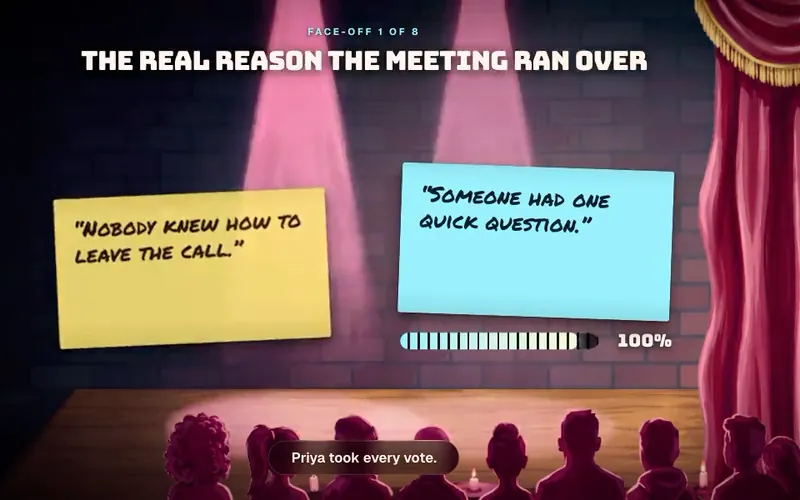
A face-off on Mic Drop's big screen, shown with sample lines.
Squadrillion, the rarest answer game
In Squadrillion, everyone answers the same prompt, such as "Name a fruit", and the rarer the answer, the deeper their submarine sinks. The lobby's rule is one line: "Say what someone else said and you share it." Each extra player with the same answer halves its depth again, for everyone who gave it.
That rule is why a crowd suits it. In a big room more answers collide, and an obvious answer shared by a dozen people barely sinks at all. Choose Free for all, "Everyone plays the seven at their own pace", and nobody waits on the slowest phone. Round by round is the better show in a smaller room.
The rules, the scoring and the prompts that play well are in how to play the rarest answer game. The free game deals seven prompts to play on your own, with no sign-up.

Squadrillion on the big screen, shown with sample players.
A live quiz
A live quiz is the plainest choice for a mixed room: timed questions, everyone answering on their phone, and a live leaderboard. It takes as long with two hundred people as with twenty, because nobody waits for a turn. Questions to start from are in trivia questions.
Where it breaks is the leaderboard. A quiz rewards whoever knows the most, so mix easy questions in with the hard ones, or the same few names top the board all night.
Guess the Doodler
In Guess the Doodler, everyone draws the same prompt on their phone at once. Then each drawing comes up on the big screen, and everyone guesses on their phone who drew it.
Every drawing gets its own guessing round, so the game grows with the room: forty drawings make forty rounds. In a big room, give it its own slot in the evening rather than a spare ten minutes.
Games that split a big room into teams
A team turns one crowd into several conversations, as long as each team is small enough to be one. Dunbar's census found that no casual group larger than six people was holding a single conversation. Fay, Garrod and Carletta, summing up earlier work, write that in discussions of ten or more people, most of the speech comes from the top four or five contributors.
Their own experiment compared the two sizes. Groups of five talked like a dialogue, and members were influenced most by the people they actually talked with. Groups of ten talked like a monologue, and members were influenced most by the dominant speaker. The task was a student committee discussing a plagiarism case, so it says more about talk than about games.
So keep teams to four to six people where you can. When the room is too big for that, pick a game in which every member of a team still plays.
Meeting Dodgeball
Meeting Dodgeball splits the room into teams of three to five, and each team steers one character on the big screen. The controls are split across the team's phones, so one player moves while another throws, catches or ducks. Everyone scans the QR code or opens the link, with no app.
Every team adds a character to the same court, so the bigger the room, the busier the screen. Meeting Dodgeball also tops out at a fixed number of players on every plan, and the pricing page gives it.
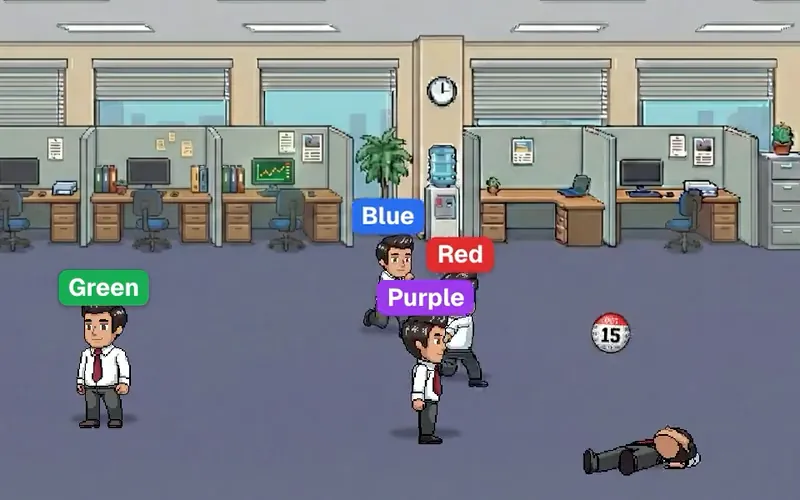
Meeting Dodgeball on the big screen, shown with sample play.
Imposter
In Imposter, everyone gets the same secret word except the imposters, who have to bluff a clue that fits. Then the room votes on who didn't know the word.
Left on its default, it plays a round in turns up to ten players, and everyone at once above that. Each clue lands on a shared wall the moment it is sent. On Auto it deals one imposter for every eight players, rounded up, so a room of eighty has ten. A host can pick from one to five instead. The lobby warns rather than refuses: "A long clue wall: rounds slow down past 40 players."
The full rules are in how to play the imposter game.
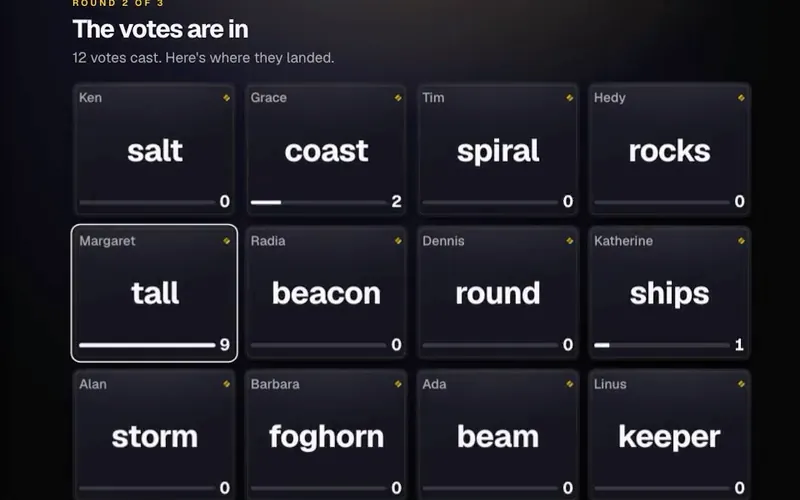
Imposter's vote on the big screen, shown with sample players.
Mafia
Mafia needs at least five players. The Mafia remove someone each night, and the town votes someone out each day. A host can deal up to six Mafia, and the lobby warns here too: "A big town: the day vote slows down past 30 players."
Mafia is the one Decka game here where people go out. A player who is out reads "You're out. Stay quiet about your role." and stops voting, so the longer the game runs, the more of the room is watching. Save it for a group that enjoys the story as much as the play. The rules are in how to play Mafia.
Questionable!, a quiz show for teams
Questionable! is a board of categories and clues for two to eight teams, and every phone in the room answers every clue. The team in control picks the tile, and the other teams answer the same clue for their own score and a steal.
Two settings matter in a big room. "Balanced automatically" means "Everyone joins the smallest team as they arrive", which copes with a room that drifts in. For the team's answer, choose "The team's most common answer": "Whatever most of the team typed when time runs out". With eight teams at most, a room of a hundred makes teams of twelve or thirteen. That setting means the answer that counts is what most of the team typed, not what its loudest member said.
The demo below plays a Questionable! board, and quiz show template covers writing one.
On the big screen
🦩Team Flamingo is picking
Team Flamingo picks the next clue, and every phone on the team gets a vote.
Games that get a big room on its feet
A room left to mingle sticks with the people it knows. Ingram and Morris hosted a mixer for almost 100 business executives and tracked who met whom with electronic name tags. Guests already knew about a third of the room, yet their encounters were split roughly evenly between old friends and strangers.
The games below fix that by deciding who meets whom.
Mingle Match
Mingle Match gives two people the same badge on their phones, such as an orange triangle, and each the other's name to go and find. Once they meet, they tap "Found them", and the phone shows a question to talk about.
A game runs three rounds by default, five minutes each, and nobody meets the same person twice. An odd room makes one group of three.
It asks everyone to stand and walk. Where some guests can't, pair seated neighbours instead.
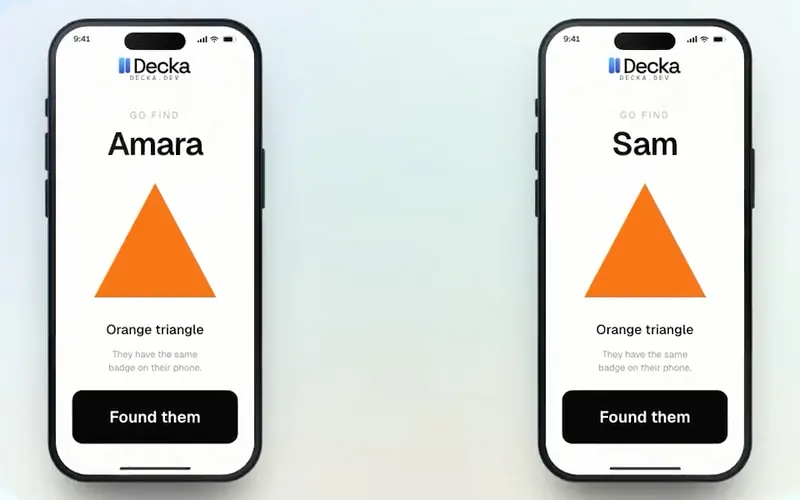
Two phones from one Mingle Match pair, shown with sample names.
Group Mixer
Group Mixer does the same for small groups. Everyone in a group gets the same badge and the others' names, and goes to find them. Groups run from three to twelve people, five by default, over two rounds of thirty minutes, with a topic to talk about unless you switch it off. Someone who arrives late joins the smallest group.
Thirty minutes is a dinner table, not a quick game. For a shorter slot, shorten the rounds, or use Mingle Match.
Four corners
Name the four corners of the room after four answers to one question, such as four places to go on holiday, and everyone walks to theirs. Then ask one person in each corner why they chose it.
It breaks when one answer is obvious and most of the room crowds into one corner. Write four answers that genuinely split a room, and put a chair in each corner for anyone who can't stand for long.
The silent line-up
Everyone lines up in order of birthday, January to December, without saying a word. Fingers and mouthed months are allowed.
One line of a hundred people is slow to sort, and its two ends can't see each other. Split the room into lines of about fifteen and race them.
A word on elimination games
Classics that knock people out, such as musical chairs and Simon says, run backwards in a big room: after a few rounds, most of the room is watching. The rock paper scissors ladder in icebreaker games is the exception, because everyone who loses joins the winner's cheering section. That page's large-groups section has more for a big room, including human bingo.
When nothing on this list fits the room
Some rooms want a game nobody has made yet. Decka Studio is for those. Its box asks "What should we make?", and the line under it reads: "Describe it in your own words. Studio builds it with you: the phone screens, the big screen and the rules". Its first idea for a party is "A bluffing game where everyone invents a fake answer, then votes for the real one".
It works in four steps: "Answer any questions Studio asks", "Approve the plan", "Watch test players play it", and "Change anything, then run it with your room". Every version is held to one rule: "Activities must pass Decka's checks before they can run, whichever AI builds them". For a big group, the check that matters most is "Running it with a full room", and the one after it is "Reading it at projector size".
As with the games above, "Everyone joins with a QR code, with no app to install." Studio activities run in PowerPoint and Decka decks. Studio doesn't make games to publish on the web, in an app store or on Roblox.
Kart Rally, a kart race, was built in Studio. The picture below comes from a test run with Studio's test players, not from a real room.
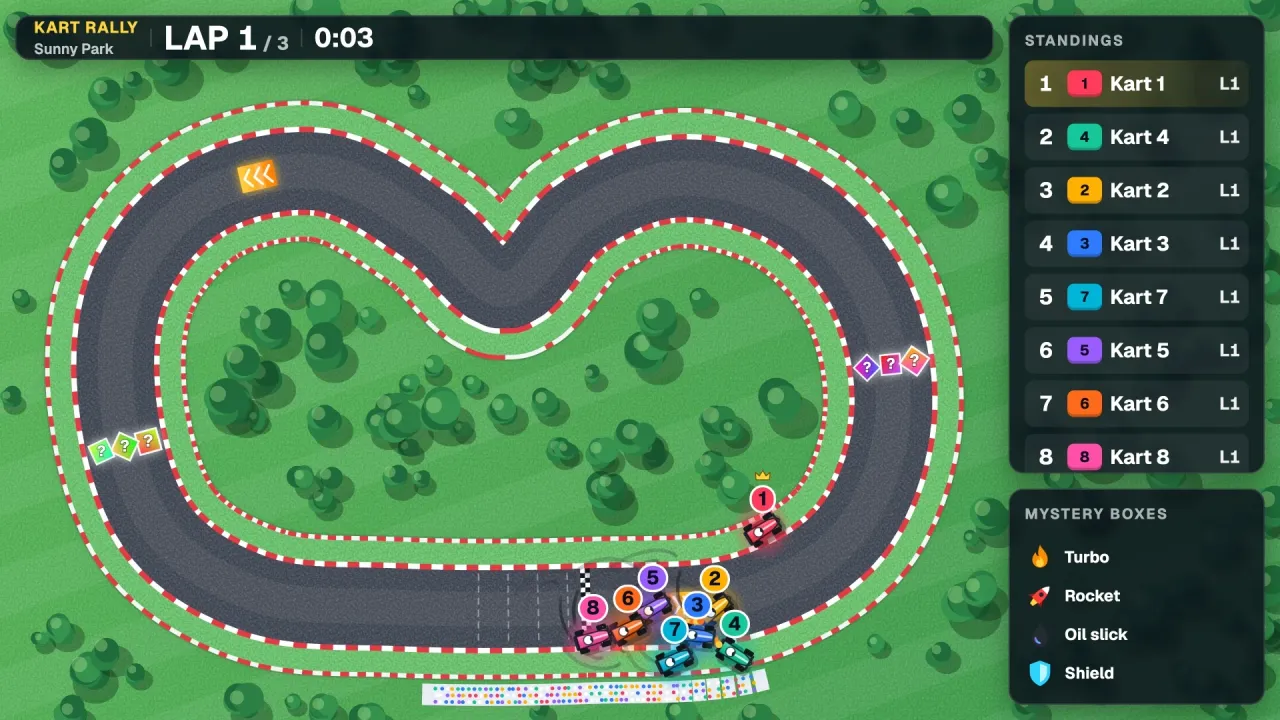
Kart Rally, built in Decka Studio, in a test run with Studio's test players.
Decka Studio's page shows how it works. Vibe coding games covers what breaks when a whole room plays a game like this, and what Kart Rally ran into.
FAQ
Common questions
What is a good game for fifty people?
One where all fifty play at the same moment. Mic Drop, Squadrillion and a live quiz have everyone answering on their own phone, and Questionable! splits the room into teams that all answer every clue. Without phones, four corners works at that size, and so does a silent line-up split into several lines.
How do you play a game with a hundred people at once?
Put the game on one big screen and let everyone answer on their own phone, so nobody waits for a turn. For a game played by voice, split the room into teams of four to six first. Check the plan as well: how many people one activity holds is on the pricing page.
What are good party games for large groups of adults?
Mic Drop's Party pack is written for them, and its line is "For adults: cheeky, never hateful". Imposter and Mafia suit a long evening with a story in it, and Squadrillion and Questionable! suit a crowd that likes a scoreboard. For a mixed-age crowd, Mic Drop's Family pack with the Family-friendly filter on checks each answer before the big screen shows it.
Can large groups play games online?
Yes. On a video call, share the screen the game is on, and everyone joins from their phone with the link. The games where everyone answers on their own phone play the same way online. The ones that need a room to walk around, such as Mingle Match and four corners, do not.
Run this with your own team
Start free, no credit card. Your audience joins from their phones with a code — nothing to install.